Category Archives: books

Amsterdam

Read this in just a couple of days. I admit that it’s a novella so not lengthy but, even so, the plot sprints along making it difficult to put down. Dark, delicious and very British, I loved it. My only criticism was that the ending seemed very slightly unbelievable but it is still a most splendid read.

(5th in 2012)

Cosa Nostra

I finished reading Cosa Nostra tonight. Given my affection for mafia-based entertainment (The Sopranos, Scorcese’s films, The Godfather Trilogy etc.) I was very much looking forward to discovering the truth behind it. Although the content of the book was interesting, my enjoyment was marred for the following reasons:

1) I frequently had to look up the meanings of words, most of which don’t occur in everyday language. Every time this happened it disrupted my flow.

2) I had to keep looking up places that were mentioned on Google maps. There are maps at the front of the book but places aren’t easily located or even present on them, as far as I could tell.

3) There are so many people involved that it’s difficult to remember who they all are. Worse still – and this isn’t the author’s fault – everyone seems to be called Giuseppe or Antonino! I had to makes notes on who was who as I went along, otherwise I got utterly confused.

4) It isn’t in strict chronological order. Where stories overlap then it’s fair enough but the author sometimes goes back and forth over the same few years. I can see that this is necessary as there are so many interwined stories – the history of the mafia is complex – but again, I couldn’t make sense of it without making notes.

I have to admit that finishing the book is a relief. I got halfway through without making notes and then had to start again because I was too confused to continue! In summary, this book is a bit too much hard work if you’re after escapism or entertainment. If you want to think and learn then by all means read it, but not without a cup of tea and a notebook.

(4th in 2012)

Julie and Julia

Julie and Julia is a charming film. It features blogging, cooking and love – three of my favourite things. There’s a scene that touched me in particular: when Julia Child’s husband gives her the book Larousse Gastronomique as a birthday present. It reminded me of how thrilled I was when I was given a copy by my husband. Not that I’ve used mine as much as Julia Child must have! I also enjoyed the portrayal of an older couple who are enthusiastic and positive about life as well as being completely in love. I hope that’s what’s in store for me.

Balthasar’s Odyssey

I bought this book on a whim. It subsequently languished untouched on a bookshelf for years. I finally picked it up about two years ago and read almost to the end. But, for reasons I can’t recall, I abandoned that attempt, even though I remember enjoying it.

This time I read it from start to finish in four days. It’s very good indeed. The language is wonderful and, in contrast to When God Was a Rabbit, a great pleasure to read. It does contain many lesser known and old words so I was constantly looking things up. This did slightly detract from the pleasure, because it disrupted the flow but I was still glad of the opportunity to increase my vocabulary.

The book is set in 1666. ‘Balthasar Embriaco, a Levantine merchant, sets out on an adventure that will take him across the breadth of the civilised world..’ It is written in diary form. This gives the book a very human perspective but plenty of history is included, though not in an overt fashion. For a person such as myself, who knows very little history, it’s a fine way to be educated. There are lessons to be learnt about religion, fear, wars, racism and more which are relevant today. But it’s not all heavy; there are hilarious moments which made me laugh out loud such as when the protagonist scorns numerical values (p76) and when he says ‘I’ve been in business all these years and I still can’t tell a pimp from an outrages father!’ on p82.

Balthasar’s Odyssey is rather unique amongst the books I have read. It is erudite but not inaccessibly so. I would thoroughly recommend it.

(3rd in 2012)

When God Was a Rabbit

This book hadn’t exactly been recommended to me, rather I was present when it was debated heatedly between two members of my family. Intrigued, I acquired it.

I didn’t get it at all. It seems so disjointed, in many ways.

The plot flits from one sensational event to another, never settling on anything for very long and leaving the reader wondering if they’ve missed something. There is much ‘and this happened then this happened then this happened’ but very little to emotionally engage the reader. I would also have to sometimes re-read a paragraph or even a page as it was unclear which character it referred to. I was irritated at the double spacing in conversations, which served to make every response seem more significant than it actually was. I continued to read through to the end, hoping for a few explanations or a conclusion to tie the book together somehow. None came.

Some aspects of the book I did enjoy. The nativity play deserves a special mention for dark humour. There are beautiful descriptions of nature. Elly’s outburst when she loses patience with Joe is very human and real. But these raw, real moments are few and far between. Most of the interactions feel wooden and stilted.

Ultimately I cannot recommend this book and don’t understand why it received so many rave reviews.

(2nd in 2012)

Thank You For The Days

Just finished reading this. A friend had told me it was good and so when I later saw a pristine copy in a charity shop for £1.25 I felt that there was not much to lose by trying it out. Unfortunately I took it with me into the pub with me one night to read while I had a nightcap and didn’t notice that the back cover and last six pages became soaked in beer when I left it on the bar. But, given MR’s affection for ale, I feel he would be proud if he knew.

So, the book. I could hear Mark Radcliffe’s voice as I read and that itself brought back many memories of when I was an avid listener of the Mark n Lard shows on Radio 1 (I don’t listen to his current Radio 2 show with Stuart Maconie, although I really should.) The Shireshorses, to me at the time, were the pinnacle of radio comedy. I would cry with laughter every time they unveiled one of their spoof ditties. And I have fond memories of sniggering at Bird Or Bloke and the other silly quizzes. He was covering familiar ground there. But there was new (to me) ground too, for example I hadn’t realised he loved walking so much. I enjoyed the chapter about his coast to coast walk from St Bees Head to Robin Hood Bay. I was a bit disappointed at his view on food though. In one of the earlier chapters he talks about having a horrible meal at Sharrow Bay in Ullswater, he gently berates the small portions in nouvelle cuisine and concludes ‘I’d finally learned the lesson Doris inadvertently taught me all those years ago. If you don’t want to try it, then don’t. Have what you know you will like and you will not be disappointed.’ If John Peel, one of his biggest heroes, had applied this attitude to music then where would be now, hmm?

But that’s a minor and subjective criticism really. The rest of the book is filled with great anecdotes about meeting famous pop stars or simply growing up. The funniest bit is when he talks about games at school, in particular the ‘horse’ which had to be vaulted over. That had me belly laughing. But the entire book is written with an endearing warmth and honesty, pretty much like his radio persona. It’s difficult not to like.

(1st in 2012)

Stuff, excess of

I found this essay about stuff by Paul Graham last year. It struck a chord at the time because we were packing to move from a bigger home to a smaller one. We gave away a lot of stuff but still brought a fair amount of it to the new place. There is now a room full of still packed stuff because it can’t be unpacked until the loft has been insulated and prepared as a storage space. So I have to wonder, if we haven’t touched all that stuff for 13 months, do we really need it? Do I even remember what it all is?

I dislike clutter. Whether PG’s theory about parsing is right or wrong I don’t know but I do know that, in my own home at least, I’m far more relaxed in a clean, tidy room than a dirty, cluttered one. So I’ve gone paper free with as many of my bills as possible and I’ve gone digital as far as possible. I download books to and use the Kindle app to read them on the iphone. I haven’t bought any CDs for quite a while, instead preferring to use Spotify. I realise that you can’t find everything on there but I find about 90% of what I want to listen to and that’s a good enough trade off for me. For films I use Sky Movies. In the rare case that I find a film that I’ll want to watch over and over again I will consider buying the disc but it’s more likely that I’ll just watch it again on Sky.

Christmas and birthdays are the worst times for accumulating things I don’t need. Specifically for these occasions I have a wish list on Amazon but sadly Kindle editions of books aren’t available as gifts yet. (Mind you, I do like ‘real’ books. I don’t class them as useless stuff, after all, they are useful when I need to save the iphone’s battery and, unlike digital editions, I can lend them to people. Anyway some books, such as cookery books, have to have a decent physical form to be of any use.) I don’t mind if people go ‘off list’ to buy me a gift provided that it’s something they’ve thought about. I have one dear friend who likes to introduce me to new books and it’s rather lovely. But on the whole I’d rather not have presents because I have everything I need and want.
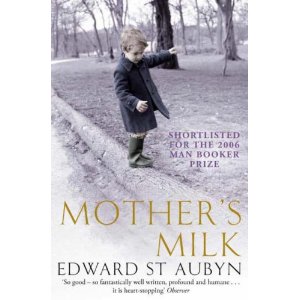
Mother’s Milk


This book describes the damaged and painful relationships of the Melrose family. It opens with a five year old’s stunning recollection of his own birth. That is the peak of the entire book. From there it slides into dull middle class family life. There is boredom, betrayal, frustration, exhaustion and obligation. While the prose is fantastic, the characters were fully formed from the beginning and I felt that I was plunged in amongst them and left to work hard on getting to know them. Admittedly this may be because I haven’t read The Melrose Trilogy which precedes Mother’s Milk.

It is touching how both Patrick and Mary are desperate not to let their families’ histories poison their sons although it’s inevitable. Their fears about the futures of their children felt tender and real. Patrick’s despairing and sometimes drunken trains of thought are also excellent. They are so vivid and insane.

Most of the characters are unlikeable because they constantly swallow down their emotions. I waited for some kind of outburst (climax?) but it never came. I didn’t get the wit either; it was just annoying, like some kind of pointless competition to say the most clever thing, when instead they should have spent some time talking sensibly to try to sort out their real problems. All the adults in the book avoid issues rather than dealing with them head on.

Summary

Well written but nothing actually happens.

Shantaram

I’ve finally finished reading Shantaram, on my third attempt to read it to the end!

The Good

I really enjoyed the travelogue aspect of it which took me back to India. I loved the parts set in the slum. He’s clearly spent a lot of time with Indians and has a great deal of affection for them.

The most unpleasant parts of the plot were the best written. His term in jail, the war and the murders and violence were all compelling.

It’s a good story with plenty packed in and has the feel of a number of books of different genres all shuffled together.

The Bad

I didn’t like any of the characters apart from Prabaker. Partly that was because there were just so many characters and he didn’t develop them very much so you didn’t get the chance to know them. Having said that I didn’t like Lin either. He always seemed to be boasting about himself: how he could speak all these languages, how he was a good fighter, how he healed people, how well he did at making money for the mafia etc. I also didn’t like the way he described how close he was to some people towards the end of the book and yet they had hardly been mentioned before that point.

The Ugly

The worst bits were the philosophical discussions (couldn’t stand all that rubbish about God being the ultimate complexity) and Lin’s romantic feelings for Karla and Lisa which made me cringe. I was also going to add all the supposedly clever stuff that people like Didier and Karla spouted but at least Lin pulled Karla up on that at the end of the book.

Summary

I’m glad I read it. It’s not the kind of book I usually go for but it was a remarkable story and made me want to go back to India.